Key Takeaway:
Quercetin is a plant flavonoid that acts as a zinc ionophore, helping transport zinc into cells where it may inhibit viral replication. Research suggests it also blocks spike protein binding to ACE2 receptors, stabilizes mast cells, and reduces NF-kB-driven inflammation central to post-COVID pathology.
Quick Answer:
Take 500-1000 mg of quercetin daily with meals containing fat for absorption, ideally paired with 15-30 mg of zinc. Quercetin phytosome or liposomal forms offer 20x better bioavailability than standard quercetin powder. It is generally well-tolerated but may interact with certain antibiotics and blood thinners.
What Is Quercetin?
Quercetin is a plant flavonoid found abundantly in fruits, vegetables, and grains. It belongs to the flavonol subclass of polyphenols and is one of the most studied dietary antioxidants in the world, with over 4,000 published research papers in the PubMed database. The compound gives many foods their distinctive yellow, red, or orange pigmentation, and it has been used in traditional medicine for centuries.
Structurally, quercetin is a pentahydroxyflavone with the molecular formula C15H10O7. Its five hydroxyl groups are responsible for its potent free radical scavenging activity, which exceeds that of vitamin C on a molecule-for-molecule basis in certain laboratory assays. In nature, quercetin typically exists as a glycoside (bonded to sugars), though supplements usually contain the aglycone (sugar-free) form for better standardization.
Beyond its antiviral potential, quercetin has been researched for benefits spanning cardiovascular health, allergy relief, cancer prevention, metabolic support, and neurological protection. Its broad spectrum of biological activity stems from its ability to interact with multiple cellular pathways simultaneously, including NF-kB (inflammation), AMPK (metabolism), and Nrf2 (antioxidant defense).
10 Research-Backed Quercetin Benefits
1. Powerful Antioxidant Protection
Quercetin is one of the most potent dietary antioxidants known to science. It neutralizes free radicals through multiple mechanisms: direct scavenging of reactive oxygen species (ROS), chelation of transition metal ions that generate free radicals, and activation of the body's endogenous antioxidant enzyme systems through the Nrf2 pathway. A 2016 study in Pharmacognosy Reviews concluded that quercetin's antioxidant capacity exceeds that of vitamin C, vitamin E, and beta-carotene in several validated assays.
This antioxidant activity is particularly relevant because oxidative stress is implicated in virtually every chronic disease, from cardiovascular disease to neurodegeneration to cancer. By reducing oxidative damage at the cellular level, quercetin may help protect DNA, proteins, and lipid membranes from the cumulative damage that drives aging and disease progression.
2. Anti-Inflammatory Effects
Chronic low-grade inflammation is increasingly recognized as a root cause of many modern diseases. Quercetin exerts anti-inflammatory effects through inhibition of the NF-kB signaling pathway, one of the master regulators of inflammatory gene expression. A 2019 meta-analysis of 9 randomized controlled trials published in Pharmacological Research found that quercetin supplementation significantly reduced C-reactive protein (CRP), a key biomarker of systemic inflammation.
Specifically, quercetin has been shown to reduce levels of pro-inflammatory cytokines including interleukin-6 (IL-6), interleukin-1 beta (IL-1B), and tumor necrosis factor-alpha (TNF-alpha). These cytokines are the same ones elevated in the "cytokine storm" associated with severe COVID-19 and in the chronic inflammation seen in long COVID patients.
3. Immune System Modulation
Rather than simply "boosting" the immune system, quercetin appears to modulate immune function, enhancing antiviral defenses while dampening overactive inflammatory responses. A 2016 study in Nutrients found that quercetin supplementation (1,000 mg/day for 12 weeks) reduced the incidence of upper respiratory tract infections in physically fit middle-aged and older adults, though results in other populations have been mixed.
Quercetin's immunomodulatory effects include enhanced natural killer (NK) cell activity, improved T-cell function, increased interferon-gamma production, and regulation of mast cell degranulation. This balanced approach to immune support makes quercetin potentially useful for both infectious disease defense and autoimmune conditions where immune over-activation is the problem.
4. Zinc Ionophore Activity (Antiviral Support)
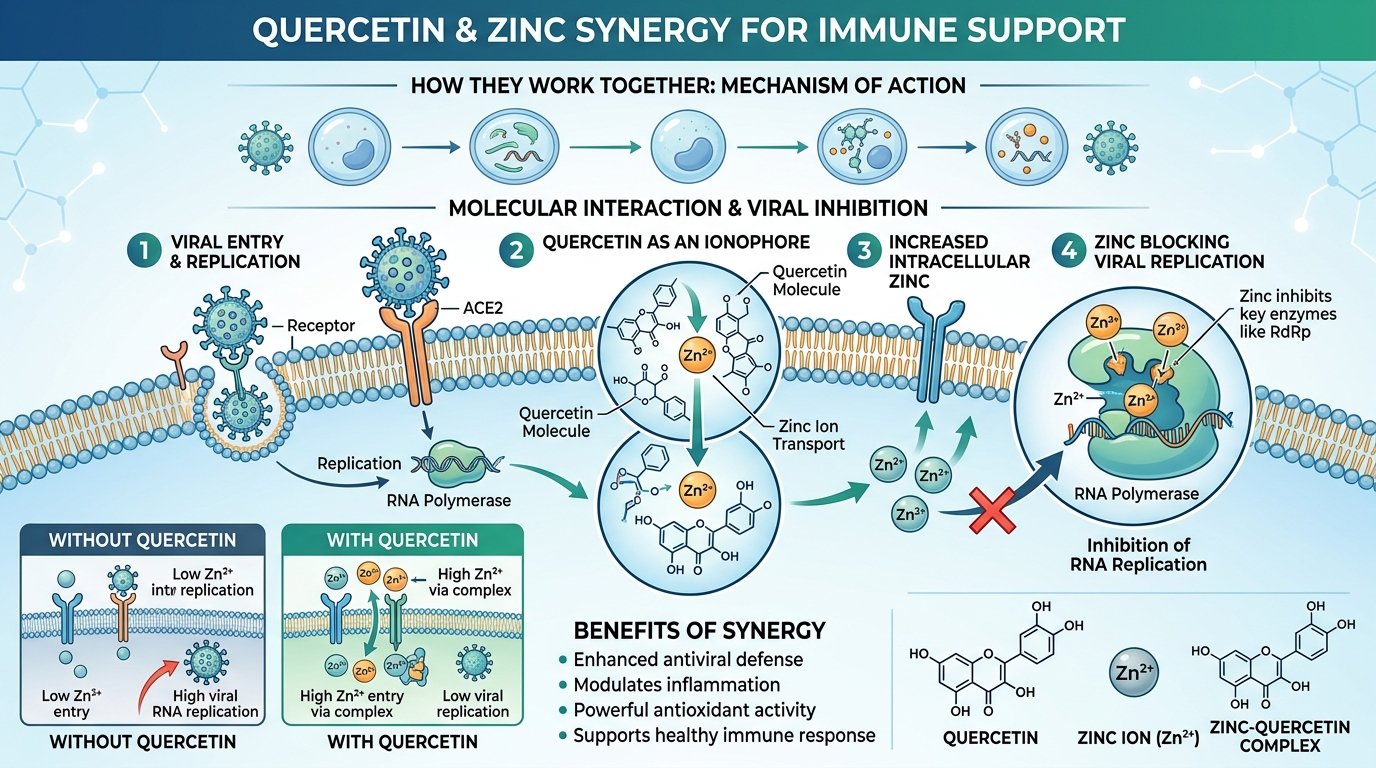
One of quercetin's most significant discoveries in recent years is its function as a zinc ionophore. Published in 2014 in PLoS ONE, researchers demonstrated that quercetin facilitates the transport of zinc ions (Zn2+) across lipid membranes into cells. Once inside cells, zinc inhibits RNA-dependent RNA polymerase (RdRp), an enzyme essential for the replication of RNA viruses including coronaviruses, influenza, and rhinoviruses.
This mechanism mirrors how hydroxychloroquine functions as a zinc ionophore, but quercetin is available over the counter and has a significantly better safety profile. The combination of quercetin with zinc has become one of the most widely recommended natural antiviral protocols, discussed in detail in the dedicated section below.
5. Allergy and Histamine Relief
Quercetin has earned a reputation as "nature's antihistamine" due to its ability to stabilize mast cells and prevent histamine release. A 2020 comprehensive review in Molecules by Mlcek et al. detailed multiple mechanisms by which quercetin reduces allergic responses:
- Direct stabilization of mast cell membranes, preventing degranulation
- Inhibition of histamine, leukotrienes, and prostaglandin D2 release
- Suppression of interleukin-4 and interleukin-13, cytokines that drive allergic inflammation
- Reduction of IgE antibody production
A 2013 randomized, double-blind study in the Iranian Journal of Allergy, Asthma and Immunology found that 8 weeks of quercetin supplementation (500 mg/day) significantly reduced nasal symptoms in patients with allergic rhinitis compared to placebo.
6. Cardiovascular Protection
Quercetin may support heart health through multiple mechanisms. A 2016 meta-analysis of 7 randomized controlled trials in the Journal of the American Heart Association found that quercetin supplementation significantly reduced systolic blood pressure, particularly in participants with existing hypertension (average reduction of 3.04 mmHg systolic).
Additional cardiovascular benefits observed in research include reduced LDL oxidation (a key step in atherosclerosis), improved endothelial function (the lining of blood vessels), decreased platelet aggregation, and protection against ischemia-reperfusion injury. These effects complement those of nattokinase, making the two supplements a logical pairing for comprehensive cardiovascular support.
7. Blood Sugar Regulation
Emerging research suggests quercetin may help support healthy blood sugar levels. A 2017 randomized controlled trial in Phytotherapy Research involving women with polycystic ovary syndrome (PCOS) found that 1,000 mg of quercetin daily for 12 weeks significantly reduced fasting glucose, insulin levels, and insulin resistance (HOMA-IR) compared to placebo.
The proposed mechanisms include inhibition of intestinal glucose absorption, enhancement of insulin secretion from pancreatic beta cells, and improvement of insulin sensitivity in peripheral tissues. A 2018 meta-analysis in Pharmacological Research confirmed significant blood sugar-lowering effects of quercetin supplementation at doses of 500 mg/day or higher.
8. Cancer Research
Quercetin has demonstrated anticancer properties in numerous cell culture and animal studies, though human clinical data remains limited. Research suggests quercetin may inhibit cancer cell proliferation, induce apoptosis (programmed cell death), suppress angiogenesis (blood vessel formation to tumors), and inhibit metastasis through multiple molecular pathways.
A 2020 review in Frontiers in Pharmacology noted that quercetin has shown activity against breast, colon, lung, prostate, liver, and ovarian cancer cell lines. The National Cancer Institute has included quercetin in its database of promising chemopreventive agents. However, it is important to note that laboratory findings do not always translate to clinical outcomes, and quercetin should not be considered a cancer treatment.
9. Neuroprotective Effects
Quercetin may protect brain health through its antioxidant, anti-inflammatory, and amyloid-inhibiting properties. A 2020 review in Frontiers in Neuroscience summarized evidence that quercetin reduces neuroinflammation, protects neurons from oxidative damage, inhibits beta-amyloid aggregation (associated with Alzheimer's disease), and enhances brain-derived neurotrophic factor (BDNF) expression.
Animal studies have shown that quercetin supplementation improves memory and learning in models of neurodegenerative disease, though human clinical trials are still in early stages. The compound's ability to cross the blood-brain barrier, while limited, is sufficient to achieve biologically active concentrations in brain tissue.
10. Anti-Aging and Senolytic Properties
One of the most exciting areas of quercetin research is its potential as a senolytic agent — a compound that selectively eliminates senescent (aged, dysfunctional) cells. A landmark 2019 study published in EBioMedicine (a Lancet journal) demonstrated that the combination of quercetin and dasatinib reduced senescent cell burden in humans, marking the first clinical evidence of senolytic therapy. Senescent cells accumulate with age and contribute to chronic inflammation, tissue dysfunction, and age-related diseases.
The Quercetin-Zinc Protocol Explained
The quercetin-zinc combination has become one of the most discussed natural antiviral protocols since 2020. Understanding how it works requires knowledge of both components' mechanisms.
How the Protocol Works
- Quercetin opens the door: Quercetin acts as a zinc ionophore, creating channels in cell membranes that allow zinc to enter cells
- Zinc enters the cell: Zinc ions (Zn2+) pass through these channels into the cell's interior
- Zinc blocks viral replication: Inside the cell, zinc inhibits RNA-dependent RNA polymerase (RdRp), the enzyme viruses need to copy their genetic material
- Result: Viral replication is slowed or halted, giving the immune system time to mount an effective response
This mechanism was first described for quercetin by Dabbagh-Bazarbachi et al. in a 2014 study published in the Journal of Agricultural and Food Chemistry, which demonstrated quercetin's zinc ionophore activity using liposome-based models. The researchers showed that quercetin transported zinc across artificial membranes in a concentration-dependent manner.
Recommended Protocol Dosing
| Component | Preventive Dose | Active Support Dose | Timing |
|---|---|---|---|
| Quercetin | 250-500 mg/day | 500-1,000 mg 2x/day | With meals (improves absorption) |
| Zinc (elemental) | 15-30 mg/day | 30-50 mg/day | With quercetin |
| Vitamin C | 500-1,000 mg/day | 1,000-2,000 mg/day | Enhances quercetin recycling |
| Vitamin D3 | 2,000-5,000 IU/day | 5,000 IU/day | With a fat-containing meal |
Quercetin and Spike Protein Research
Several studies have investigated quercetin's potential interactions with SARS-CoV-2 spike protein:
A 2020 computational study published in Frontiers in Immunology by Colunga Biancatelli et al. examined the synergistic effects of quercetin and vitamin C against SARS-CoV-2. The researchers found that quercetin may interfere with spike protein binding to ACE2 receptors through molecular docking simulations, potentially reducing viral cell entry.
A 2021 molecular dynamics simulation published in Journal of Biomolecular Structure and Dynamics showed that quercetin exhibited strong binding affinity to the receptor-binding domain (RBD) of the SARS-CoV-2 spike protein, with binding energy comparable to some pharmaceutical candidates under investigation. The study suggested quercetin could potentially disrupt the spike protein-ACE2 interaction.
Additionally, quercetin's anti-inflammatory effects may help mitigate the downstream damage caused by spike protein-mediated inflammation, regardless of whether it directly blocks spike protein binding. The NF-kB inhibition, cytokine reduction, and mast cell stabilization provided by quercetin address several of the pathological mechanisms attributed to persistent spike protein.
Quercetin Dosage Guide
| Purpose | Daily Dosage | Form | Duration |
|---|---|---|---|
| General antioxidant support | 250-500 mg | Standard or phytosome | Ongoing |
| Allergy/histamine relief | 500-1,000 mg | Standard quercetin | Seasonal or ongoing |
| Immune support (with zinc) | 500 mg + 15-30 mg zinc | Standard or phytosome | Ongoing |
| Spike protein protocol | 500-1,000 mg 2x/day | Phytosome preferred | 3-6 months |
| Cardiovascular support | 500 mg | Standard or phytosome | Ongoing |
| Blood sugar support | 500-1,000 mg | Standard quercetin | 12+ weeks |
Top Quercetin Food Sources
While therapeutic doses typically require supplementation, incorporating quercetin-rich foods into your diet provides additional phytonutrients and co-factors that may enhance quercetin's effects:
| Food | Quercetin (mg per 100g) | Serving Size | Quercetin per Serving |
|---|---|---|---|
| Capers (raw) | 234 mg | 1 tbsp (9g) | ~21 mg |
| Red onion (raw) | 32-45 mg | 1 medium (110g) | ~40 mg |
| Cranberries (raw) | 15-25 mg | 1 cup (100g) | ~20 mg |
| Kale (raw) | 7-23 mg | 1 cup chopped (67g) | ~10 mg |
| Apples (with skin) | 4-7 mg | 1 medium (182g) | ~10 mg |
| Blueberries | 3-8 mg | 1 cup (148g) | ~8 mg |
| Broccoli (raw) | 3-4 mg | 1 cup (91g) | ~3 mg |
| Green tea (brewed) | 2-3 mg | 1 cup (240ml) | ~3 mg |
As the table illustrates, even a diet very rich in quercetin-containing foods would provide only 50-100 mg of quercetin daily — well below the 500-1,000 mg used in clinical studies. This is why supplementation is typically recommended for therapeutic purposes.
Bioavailability: Standard vs. Phytosome
One of the biggest challenges with quercetin supplementation is its poor natural bioavailability. Standard quercetin aglycone has an estimated oral absorption rate of only 2-17%, meaning most of what you swallow never reaches your bloodstream.
Why Standard Quercetin Has Low Absorption
- Low water solubility limits dissolution in the gut
- Rapid first-pass metabolism in the liver converts much of it to inactive metabolites
- Efflux transporters in intestinal cells pump quercetin back into the gut lumen
- Gut microbiota degrade a portion before absorption
Enhanced Bioavailability Forms
- Quercetin Phytosome (Quercefit): Sunflower lecithin encapsulation. Up to 20x more bioavailable than standard quercetin in published pharmacokinetic studies. The gold standard for absorption.
- Quercetin Dihydrate: Crystalline form with improved dissolution. Moderately better than standard aglycone.
- EMIQ (Enzymatically Modified Isoquercitrin): Glycosylated form with 3-5x better absorption than standard quercetin.
- Quercetin with Bromelain: Bromelain may enhance quercetin absorption through anti-inflammatory effects on the gut lining. Many supplements combine these two ingredients.
Side Effects and Drug Interactions
Quercetin is generally well-tolerated at doses up to 1,000 mg/day in clinical trials lasting up to 12 weeks. Common side effects are mild and include:
- Occasional headache
- Mild gastrointestinal discomfort (nausea, stomach upset)
- Tingling in extremities (rare, high doses)
- Fluoroquinolone antibiotics (ciprofloxacin, levofloxacin): Quercetin may compete for the same bacterial targets, potentially reducing antibiotic efficacy
- Cyclosporine: Quercetin may increase cyclosporine blood levels by inhibiting CYP3A4 metabolism
- Blood thinners (warfarin): Quercetin may enhance anticoagulant effects
- Antihypertensives: Quercetin may add to blood pressure-lowering effects
- Chemotherapy drugs: Quercetin may interact with doxorubicin and cisplatin; consult oncologist
People with kidney disease should use quercetin cautiously, as very high doses (over 1,000 mg/day) have been associated with kidney stress in animal studies. Pregnant and breastfeeding women should limit quercetin intake to dietary amounts, as safety data for high-dose supplementation during pregnancy is insufficient.
Synergistic Combinations
Quercetin works best when combined with complementary compounds that enhance its absorption, extend its duration of action, or provide additive health benefits:
- Quercetin + Zinc: The zinc ionophore protocol described above. Take together for antiviral support.
- Quercetin + Vitamin C: Vitamin C regenerates oxidized quercetin, extending its antioxidant lifespan. A 2020 study in Frontiers in Immunology found this combination showed synergistic antiviral and immunomodulatory effects.
- Quercetin + Bromelain: Bromelain enhances quercetin absorption and adds its own anti-inflammatory and proteolytic benefits. Many supplement manufacturers combine these ingredients.
- Quercetin + Nattokinase: Quercetin's anti-inflammatory and antiviral effects complement nattokinase's fibrinolytic and spike protein-degrading activity. Together, they address both the inflammatory and thrombotic aspects of spike protein-related conditions.
- Quercetin + Curcumin: Both compounds inhibit NF-kB and reduce inflammatory cytokines through different molecular mechanisms, providing broader anti-inflammatory coverage.